Most retention strategies wait for the cancellation email to arrive, then scramble to win customers back. But the best systems know a customer is at risk before they do, using behavioral patterns, engagement trends, and health scores to trigger proactive interventions that prevent churn before it starts. By embedding predictive analytics and AI-driven segmentation into your lifecycle automation, you shift from reactive retention campaigns to a true loyalty operating system that adapts in real time.
This evolution marks a fundamental shift in how businesses approach customer relationships. By 2026, customer retention automation is moving beyond basic scheduled workflows to become predictive, real-time systems. These sophisticated engines combine AI, CRM data, diverse engagement channels, and nuanced loyalty mechanics into a cohesive lifecycle management framework. Retention is no longer an afterthought or a post-purchase add-on; it’s an integral operating system designed to reduce churn, significantly increase customer lifetime value, and orchestrate timely, relevant engagement across every stage of the customer journey, from initial onboarding and adoption to renewal and even reactivation.
Data, Decisioning, and Delivery
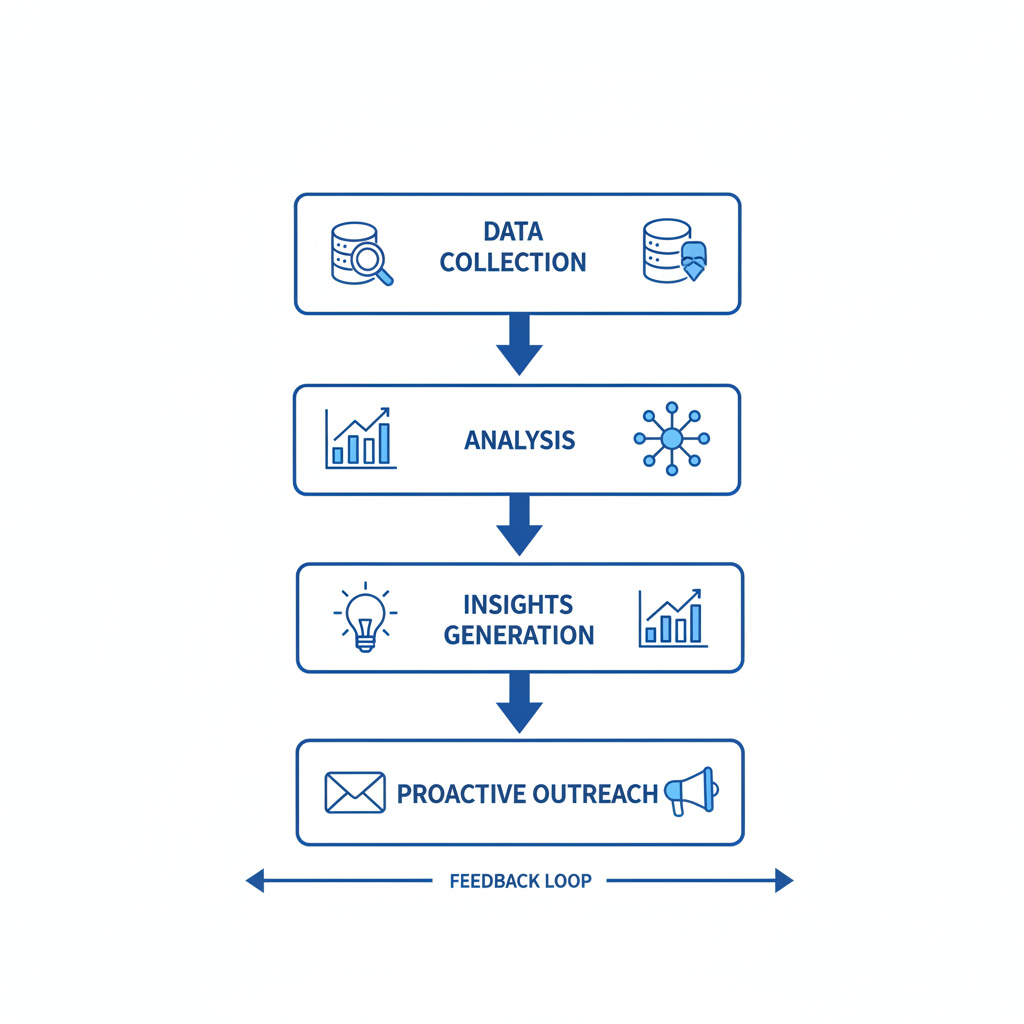
At its core, modern retention automation thrives on the seamless connection of three critical layers: data, decisioning, and delivery. The data layer is the foundation, drawing insights from product behavior, support ticket interactions, comprehensive CRM records, and direct customer feedback. This rich tapestry of information fuels the decisioning layer, where AI and predictive analytics work in tandem to identify subtle churn risks, dynamically segment users based on evolving behaviors and needs, and intelligently recommend the most effective next best actions. Finally, the delivery layer ensures these insights translate into meaningful interactions, reaching customers through automated emails, in-app messages, SMS, push notifications, chat, and other omnichannel touchpoints precisely when and where they are most impactful.
Predictive Churn Prevention
A cornerstone of this new era is predictive churn prevention. Instead of waiting for explicit signals of dissatisfaction, advanced retention tools forecast risk by analyzing behavioral patterns, monitoring engagement trends, and calculating automated health scores. This proactive approach transforms event-driven automation, turning historical and real-time product signals into intelligent triggers that preemptively address potential issues. Predictive analytics and automated health scoring are no longer optional extras but essential components for any forward-thinking retention strategy.
Hyper-Personalization
This predictive capability is intrinsically linked to hyper-personalization. Retention programs are rapidly moving away from broad, static customer segments towards dynamic, AI-driven segmentation. This allows for highly personalized messaging and interventions tailored to individual behavior, lifecycle stage, expressed preferences, and past interactions. The impact of such personalization is substantial; benchmark data suggests that segmented email campaigns significantly outperform non-segmented ones, automated retention emails generate more revenue than broadcast messages, and AI-driven personalization can materially improve retention rates compared to simpler rule-based approaches.
The Customer Lifecycle Perspective
The customer lifecycle perspective is paramount in orchestrating effective retention automation. A robust system organizes its efforts around distinct journey stages: onboarding, activation, adoption, renewal, expansion, and win-back. Mapping these customer journey touchpoints is the crucial first step, enabling teams to identify and address the biggest bottlenecks with the right automation capabilities. For instance, onboarding automation is vital for early-stage customers who might be stalling, while churn prediction and renewal workflows become critical for accounts nearing the end of their contract term.
Omnichannel Orchestration
Complementing the lifecycle approach is omnichannel orchestration. Retention efforts are increasingly viewed not as siloed, channel-specific campaigns but as a unified, coordinated system across email, SMS, push notifications, in-app messages, chat, and support channels. The goal is to avoid over-messaging and ensure relevance by intelligently coordinating timing, context, and message frequency across all touchpoints. This integrated approach ensures a consistent and supportive customer experience, no matter the channel.
Customer Loyalty Automation
Customer loyalty automation is also being deeply embedded within broader retention stacks. Standalone loyalty platforms are becoming less common as loyalty features are integrated directly into comprehensive retention ecosystems. This means rewards, tiered programs, referral incentives, and personalized perks can be triggered dynamically by customer behavior, value milestones, or even risk signals, rather than being managed as a separate, disconnected initiative. Supporting statistics indicate that personalized rewards and tiered programs can significantly boost engagement and repeat purchases, making loyalty automation a powerful subset of overall lifecycle automation.
Building Sophisticated Systems
For enthusiasts of automation, AI, and vibecoding, the buildable nature of modern retention systems is particularly exciting. These systems are constructed on connected data models, shared identifiers, event streams, and robust integrations, often augmented by AI assistants that recommend or even execute next steps. This empowers teams to design sophisticated retention workflows using no-code and low-code builders, seamlessly connecting product events, CRM records, and messaging tools into automated playbooks. The fundamental pattern is clear: detect a behavior, score its significance, decide on the appropriate action, and deliver the right message through the optimal channel.
Integrating Customer Success and Support
A strategic approach to retention automation also necessitates integrating customer success and support functions. Customer success tools are instrumental in enabling health scoring, onboarding automation, engagement tracking, churn prediction, and data centralization. This means retention automation should encompass proactive support workflows, automated outreach for users experiencing difficulties, and AI-generated summaries or draft responses to reduce the manual workload for customer-facing teams.
Data Governance and Privacy
Crucially, data governance and privacy must be at the forefront, especially as CRM trends in 2026 emphasize connected customer data, consent, transparency, and minimized exposure of personal data. While advanced retention automation relies on comprehensive data collection and behavioral tracking, higher levels of automation maturity demand robust preference management, clear data ownership, and trustworthy first-party data practices. For a technically inclined audience, this highlights that the most effective systems are not only smarter but also better governed and more secure.
Pillars of Retention Automation
Implementing a sophisticated retention automation strategy can be structured around several practical pillars. First, clearly define retention automation and articulate its financial importance—reducing churn, increasing customer lifetime value (CLTV), driving referrals, and boosting loyalty. Second, understand the core mechanics: tracking user behavior, scoring accounts, predicting churn, and triggering workflows in real time. Third, explore the main use cases, including onboarding nudges, activation reminders, renewal alerts, win-back campaigns, loyalty triggers, and feedback loops. Fourth, consider the technology stack, encompassing CRM, a customer data layer, an automation engine, AI assistants, messaging channels, and analytics. Finally, focus on implementation guidance: begin with journey mapping, identify a high-friction lifecycle stage, connect your data sources, define clear triggers, and continuously iterate based on performance metrics.
Key Metrics
Key metrics to monitor include churn rate, renewal rate, customer lifetime value, repeat purchase rate, engagement rate, response time, support resolution time, and net revenue retention. For a more strategic view, consider measuring loyalty automation by incremental repeat purchases and reactivation rates, rather than solely focusing on campaign opens or clicks.
The Future of Retention Automation
Ultimately, the most compelling aspect of customer retention automation in 2026 is its emergence as an agentic, connected, and predictive force. Systems are no longer passive executors of scheduled tasks; they actively interpret signals, intelligently choose actions, and adapt dynamically across the entire customer lifecycle in real time. This sophisticated, responsive approach to customer relationships promises to redefine loyalty and drive sustainable growth for businesses that embrace it.
Book a 15 minute discovery call to find out more today at https://digifidelis.com/calendar/