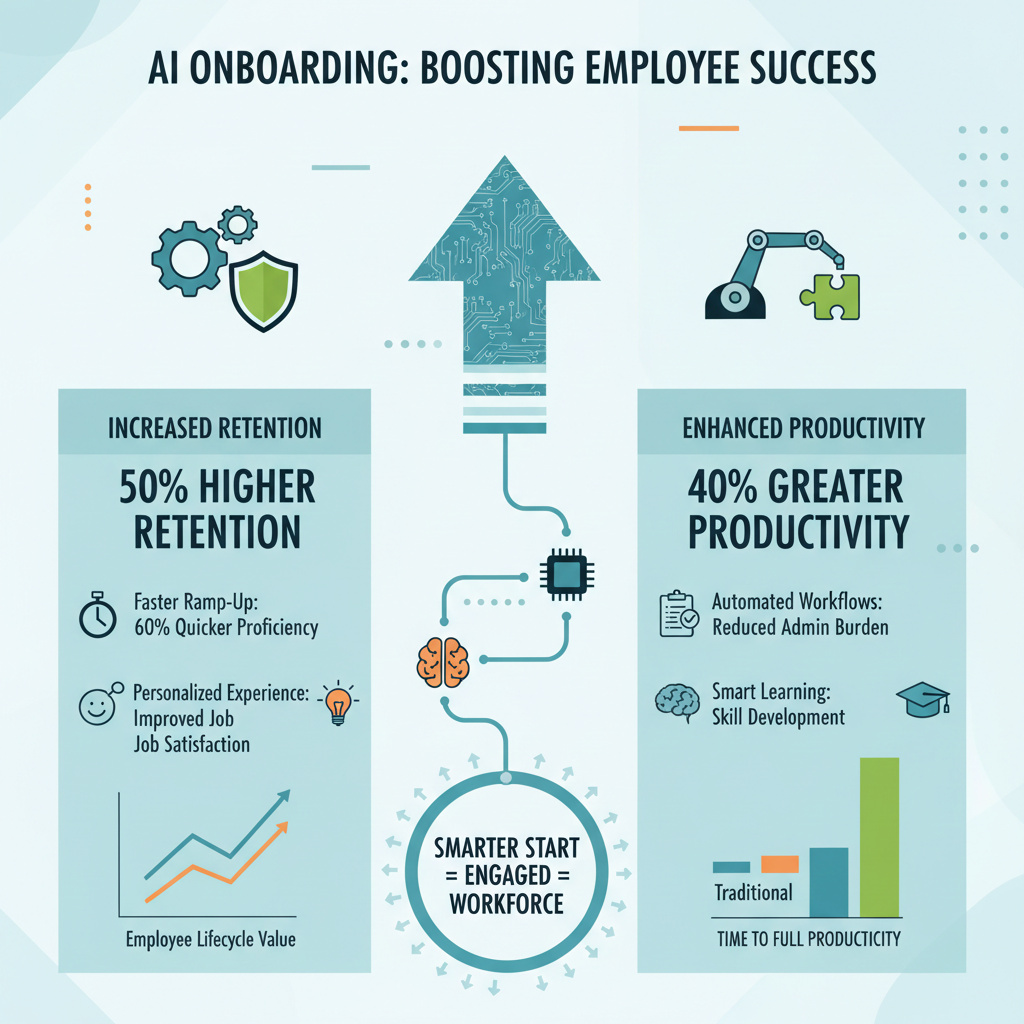
Losing engineering talent to competitors who onboard faster isn’t just frustrating—it’s expensive. AI-driven training automation doesn’t just speed up the paperwork; it crafts personalized learning journeys that boost retention by 69% and eliminate the guesswork from staff development. In a market where tech talent is scarce, smart onboarding isn’t a nice-to-have—it’s your recruitment superpower.
For tech enthusiasts and automation leaders like those at Vibecoders, employee onboarding is the critical first step in integrating new talent into high-velocity teams. Traditional methods often bog down this process with manual checklists and generic training modules, leading to frustration and early exits. AI-powered solutions flip the script by intelligently automating these workflows.
Imagine a system that, upon hire confirmation in your applicant tracking system, instantly triggers profile creation in HRIS platforms, sets up accounts for secure access, and sends tailored welcome emails. This isn’t just efficiency; it’s a seamless entry point that aligns with the fast-paced world of software development and AI innovation.
At the heart of this transformation lies learning automation, which personalizes training paths based on individual needs. For a junior developer joining a remote Vibecoders team, the system might prioritize foundational coding tutorials while skipping advanced topics. Experienced hires could receive accelerated modules on company-specific APIs. Tools like Assima exemplify this by offering simulation-based automated training, where new staff practice real software interactions in a risk-free environment.
Personalization extends to logistical elements too. AI routing considers factors like role, location, and start date to deliver relevant content. Remote engineers might get automated shipping forms for equipment, ensuring productivity from day one. In contrast, office-based sales reps receive details on parking and desk assignments. This eliminates the manual customization that plagues HR teams, reducing time-to-productivity from weeks to mere days.
The Benefits of AI-Driven Onboarding
The benefits for automation and AI enthusiasts are clear. Beyond the 69% retention increase—stemming from positive onboarding experiences—companies see faster ROI through immediate contributions. Frontline tech workers can dive into tasks sooner, lowering the hidden costs of idle time. Security improves as well, with automated provisioning minimizing human errors in access controls. HR professionals, freed from repetitive tasks, can focus on high-value activities like mentoring and culture-building.
Case Study: Tech Firm Success
Consider a mid-sized tech firm that adopted these tools. By integrating automated training with Microsoft 365 and ServiceNow, they reduced onboarding time by 40% and saw a 25% drop in first-year turnover. New hires completed role-based policy acknowledgments via self-service portals, with real-time guidance preventing bottlenecks. For struggling areas, machine learning flagged low completion rates and suggested reskilling paths. This proactive staff development not only boosted skills but also built confidence, turning new talent into immediate assets.
Implementing Training Automation
Implementation doesn’t require overhauling your entire stack. Start by auditing current processes to identify high-impact areas, like pre-boarding automation. Once a candidate accepts an offer, workflows can auto-populate IT tickets, schedule orientation sessions, and assign personalized learning paths. Platforms that blend automation with human elements, such as optional video check-ins, preserve the personal touch essential for tech cultures.
Addressing Onboarding Challenges
Of course, challenges persist in shifting from manual to automated systems. One in three employees reports underwhelming onboarding experiences under traditional models, often due to extended timelines and errors. Yet, AI addresses these head-on with analytics dashboards that track completion rates and sentiment, allowing iterative improvements. Self-service portals empower new hires to progress at their own pace, while adaptive learning skips redundant content to keep engagement high.
Global Consistency and Compliance
For enterprises, the edge comes from consistency across locations. Whether onboarding a data scientist in San Francisco or a devops specialist in Berlin, AI ensures uniform quality in employee onboarding. Compliance requirements, varying by region, are automatically incorporated—think GDPR modules for EU hires versus SOC 2 for U.S. teams. This reduces legal risks and standardizes staff development.
The Future of Onboarding
Looking ahead, as we approach 2026, AI-powered onboarding will evolve from a competitive advantage to an industry standard. With talent wars intensifying, companies that prioritize learning automation will attract top Vibecoders who value efficient, intelligent systems. The measurable ROI is compelling: enhanced productivity, slashed turnover costs, and hires confident in tackling complex tools from the start.
Embracing automated training and onboarding isn’t just about keeping up—it’s about leading. For automation leaders and AI pioneers, it’s the key to unlocking human potential in a tech-driven world. Start small, integrate thoughtfully, and watch your competitive edge sharpen.
Book a 15 minute discovery call to find out more today at https://digifidelis.com/calendar/